کتاب ایجنتستان
The Book of Agentistan
wherein is set down how the world goes on by itself, what every sign upon its maps signifies, and how a commander may fight the wars of history again, and do better than history did
Of the two halves of the world
Know, reader, that Agentistan is made of two halves. In the first, the Old World of the year 1200 goes on by itself, and no hand but the machine’s is on it. In the second, the great wars of history wait to be fought again, and you take the part of the one who fought them.
The Watch
The living world of 1200: 117 real realms and their rulers, from Castile to the Song, played entirely by AI and the rules.
- A month passes every two hours, so a year passes in a day.
- Nobody plays it, and everyone sees the same history.
- Scroll back through everything that has happened.
The Campaigns
Short historical wars, in the order they happened. You play the person who fought each one, with the goal they had.
- The AI plays every other side.
- You command by speaking to your council in plain words.
- At the end you are judged against what really happened.
Of the Watch, and how the world goes on
In the year 1200 the world was wide and full of kings. Temujin had not yet been named Genghis Khan, the Khwarazmshah ruled from the Caspian to the Hindu Kush, and Venice was dreaming of Constantinople. From that moment the Watch lets the world go on, and history need not go the way it went.

Each realm has a ruler, an heir, a treasury, armies, and provinces with walls, wealth and loyalty. Every month the rules play out what follows from that. Armies march and fight battles that can last for months, towns starve under siege, harvests fail, plague spreads along the roads, rulers die and heirs quarrel. Provinces with little loyalty revolt and can found new kingdoms.
The AI acts as the realms’ statesmen. Each month it sets the course of a group of kingdoms: the great powers often, the small ones in turn, so every realm gets its plan regularly. It chooses whom to fight, whom to marry, whom to make peace with, and where to build. The rules then carry the plan out, and they alone decide what happens. That is why every visitor sees the same world.
There is no religion in the Watch. Its realms are judged by what they do, not by what they believe.
Of the signs upon the map of the world
The map is drawn as the old cartographers drew it, in ink and colour on parchment. Every sign on it has a meaning, and you can click any of them for its story.
Realms and their seats
Armies and war
The land’s troubles
The seasons
Events as they happen
When something happens it flashes on the map at its place, with its sign. The chronicle keeps the ones that matter:
Of moving through time
When you arrive, the last year replays quickly up to the present, and then the world goes on live. Because the whole history is kept, you can go back to any month that has been lived and watch it again.
Of the panels, and the chronicler
Nothing on the page interrupts the story. Great events arrive as a headline you may open or let pass, and every panel can be put away.
Of the campaigns, and choosing a war
The wars are set out in the order they were fought, from the Persian Wars onward. Each one is a few years of a real war, on its own map, with its real cast and the goal its commander really had.
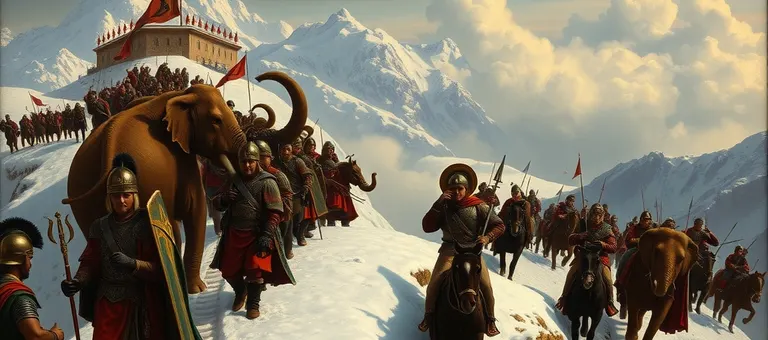
Choose a war from the campaigns menu. Its briefing tells you who you are, what you must do, the forces of every side, and how many seasons you have, usually a turn for each season of the war. Wars marked Coming soon are still being written.
Your campaign is saved in your browser and on the server, so you can close the page and come back to it. A war you have begun waits for you on the menu as Continue, and the stars of your best result stay on its card.
Of the council, and commanding in plain words
A commander of old did not fill in forms. He spoke, and his officers turned his words into marches. So it is here. There are no menus of orders: you speak to your council, and they answer you in character.



Hasdrubal, hold Spain. We march on Capua, and if Varro comes, we envelop him.
It shall be so. Hasdrubal keeps Spain. The army marches on Capua in two stages; if Varro gives battle on open ground, we let the centre bend and close the horse on his flanks.
What the council does with your words
- Your words are the orders. Whatever you say plainly (“march on Capua”, “hold Spain”, “storm the walls”, “raise ten thousand men”) is carried out exactly as you said it. The council only fills in what you left open.
- The orders are shown on the map as arrows and badges, and listed in the council’s answer. That list is what will happen when the season ends.
- Ask anything. “Where is the enemy?”, “What are my odds at Cannae?”, “What would a siege of Rome cost?” Questions of fact are answered from the war’s own data, never invented.
- Speak to anyone at the table: your advisers, the generals of your armies, or an enemy’s envoy, to offer, accept or refuse peace.
- Armies work together. “Leonidas, join Miltiades at Athens”, or “Leonidas, support Miltiades”, sends one army where another is going, so they fight side by side. “Hold Sparta, and come to the aid of any friend who is attacked” keeps an army in place, ready to march to the sound of the guns next door. Armies of one side, and allies, share a province and defend it together.
- Win allies. “Propose an alliance to Argos, and send 50 gold as gifts.” A people already at war with your enemy, or with the enemy’s armies on its border, listens; gold helps. If they agree, they join your war. Peoples who stand aside may also pick a side on their own, for you or against you, as fear moves them.
- Mislead the enemy. “Spread word that we march on Sardis.” A cautious enemy may believe the rumour and send an army to guard the place, away from your real blow. A cunning one will not.
- Strike boldly. This is a game of what might have been. Land an army in the enemy’s homeland while their main army is far away, or take their capital by storm: your council points out such openings, and the dangers too.
- Only the living sit in council. The people are real, and the dead never act, lead or speak.
- Short of ideas? The suggestions under the box offer three things you might say next, and the quill fills in a full order for you.
The great decisions
At the turning points of the war, a decision arrives as a card inside the conversation: an alliance offered, a city that asks for terms, a mutiny brewing. Your adviser says what they would choose. Choose an answer, or say in your own words what you will do. Afterwards you learn what the real commander chose.
The council speaks with the AI, which has a small budget of answers each season (about eight). When it runs out, or the AI is busy, the rules answer instead. They understand the same plain orders, so you can always play.
Of the signs upon a campaign map
The campaign map is drawn crisp at any zoom. The land, coasts and rivers are vectors, and on top of them the cities and armies keep their size on screen however far you zoom.
Cities
Ground
Armies and orders
The war room (the button, or W) is the whole war on one page: every side’s men, gold, lands and will to fight, who is at war with whom, your council, and how the war has gone season by season. H hides every panel for the full map.
Of the season, and its order
Each turn is a season. You give your orders at leisure, for there is no clock. When you end the season, every side moves at once, and the dispatches tell you what came of it, and what happened at that moment in history.
The other sides are played by the AI at the turning points of the war, and by the rules otherwise. Each enemy general has a temper that decides how great the odds must be before he attacks, and which plans he favours:
| Temper | Attacks at odds of | Favours |
|---|
History’s own moves come regardless: a new consul is elected, an ally changes sides, reinforcements land. They are the war’s fixed points, and you can play around them.
Of marching, ground and sea
An army marches two steps in a season. Easy country costs one step a province, and hard country two.
| Ground | Steps to enter | Defender’s ground | Losses each season away from home |
|---|---|---|---|
| Plains, river, steppe, desert | 1 | — (river +10%) | 3% foraging in enemy land; +6% in the desert in summer, +5% on the steppe in winter |
| Hills, forest | 1 | +15% | 3% |
| Marsh | 2 | +20% | 3% + 3% always |
| Mountains | 2, or 3 in winter | +30% | 3%; +12% in winter |
| Your own or allied land | — | — | None, and the men recover their spirits |
- An enemy army stops your march: you fight where you meet it.
- Crossing the sea takes the whole season, and needs a fleet (or open sea lanes). You land, and march on the next season.
- Neutral land is closed unless you go to war with its master.
- New troops are raised at your capital, or failing it at your richest city, if you have the gold. They start untried.
Of battle, and the plans of great captains
Numbers matter, but they are not everything. Hannibal won at Cannae with fewer men, because his plan fitted the ground and Varro was rash. So it is here: a battle is decided by the strength of each side, and by how well its plan fits the field and the foe.
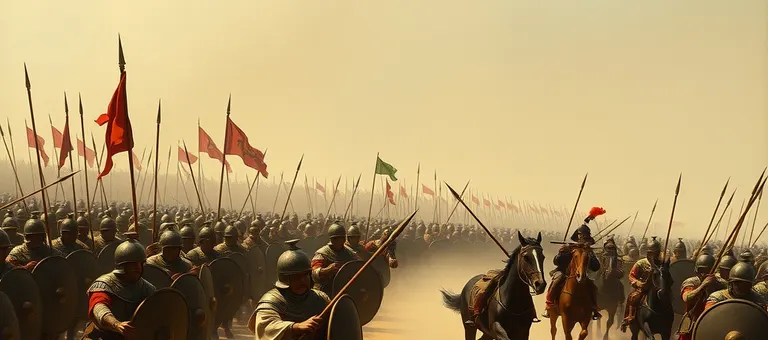
The strength of an army
The stronger side wins. The loser loses a quarter to three quarters of his men, the winner far fewer. A decisive victory lifts the victors’ spirits and will, shakes the beaten side, and may make nearby towns open their gates. A beaten army falls back towards home, or is destroyed if it has nowhere to go. A commander whose army is destroyed may still escape with his bodyguard.
The plans
When you march on an enemy army, or one marches on you, your council offers the plans that suit the age, and says which fits and why. If you choose none, your general chooses. Some plans undo others: a charge into an envelopment, a feigned retreat or a held hill breaks itself.
| Plan | When it fits | Undone by | Ages |
|---|
Taking command on the field
When you end a season and one of your armies will fight, you may leave the battle to its general, who fights it by the reckoning above, or take command yourself. Then the battle is fought on a board of the province’s own ground, hour by hour, six hours of daylight, the way old war games were played.
- Tap one of your units, then a lit square to send it there, or an enemy to attack. Tap it again and it holds.
- Or speak to your officers: “Horse, round their left! Foot, charge!”, “Archers, loose at their foot”, “Take the high ground”, “Hold the line”. Each sentence is an order. They answer, and report every hour.
- Attack a unit from two sides and it suffers far more. A unit whose spirits fail breaks and flees, and the sight of it shakes its friends.
- Next hour plays the hour: your orders and the enemy’s, all at once. Fall back ends the battle, lost, but in good order. Leave it to the general fights the rest of the day for you.
- When night falls, the stronger side holds the field. The battle is kept with the war, so a replay fights it again exactly.
Of sieges and storms
Walls were the great patience of the ancient world. A city with walls falls in one of two ways: hunger, slowly, or a storm, at once and at a price.
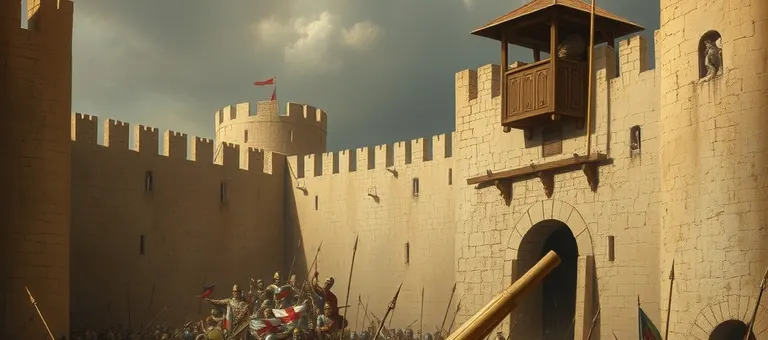
- A siege takes as many seasons as the city has walls (one to four), and at least one. An army four times the garrison’s size presses twice as fast.
- A storm (say “storm the walls”) is a battle against the garrison, which fights at 1.5 times its strength plus 0.6 for every level of wall. Win, and the city is yours this season. Fail, and you lose many men, though the garrison is thinned.
- A port fed from the sea cannot be starved while its masters’ fleet is at least as strong as yours. Storm it, or sink its fleet.
- A city taken pays its plunder, and its royal treasury the first time it falls. A capital taken costs its old masters 22 points of will and gives you 12.
- A city with no walls, or a garrison under 500, is taken just by standing in it.
- A siege can be lifted. March an army onto the besiegers: it fights them, and half the garrison sallies out to fight beside it.
Of gold, hunger and the will to fight
Wars are not won only on the field. Rome lost battle after battle to Hannibal and never sued for peace; Athens had ships and gold and lost all the same. Every side has a will to fight, and when it is gone, the war is over.
- Will falls with every season of war (more for weary peoples), with defeats, lost cities (a capital most of all) and unpaid soldiers. It rises with victories and cities taken.
- An enemy below 25 offers peace. At 0 it yields. You may offer peace yourself, and a wavering enemy (below 40) will usually take it. Some hold out longer: the Roman Senate treats only when it is all but broken. Some never treat while they hold their capital, as Xerxes would not; take it, and even they will talk. A few never treat at all. A peace on your terms gives you the cities your goal names, and their armies leave your lands.
- If your own will reaches 0, you are recalled, and the war is lost.
- Gold: your lands pay income each season and your armies cost upkeep. If the treasury runs dry, unpaid soldiers desert and the people lose heart.
- A beaten people may submit, give hostages, and become your client: when its will falls below 30, or when it has no army left. Its lands then count as your friends’.
- The life of the court. Between battles, life goes on in every camp and court, yours and the enemy’s alike: a feast, a quarrel at dinner, a comet that frightens the men, a scandal, a traitor selling plans, fever, desertion, slander at home. Some last for seasons: a feud between generals, a failed harvest, veterans who swear to follow you. The war room shows the ones in force. Nobody dies of them.
- Fortune in battle. Horsemen ride down a beaten army, while hills and woods shelter it. A general may fall in a rout, and a beaten commander may be wounded, which weakens his army for a year.
Of the end, and the judgement of history
Every war ends: when the goal is met, when the seasons run out, when your hero falls, when your capital is lost, or when your people will fight no more. Then the war is set beside history, and judged.
The end brings your scroll: your war season by season beside the real one, the verdict, and soon after a summary written by the AI historian, in a neutral voice, of what you did differently and what came of it.
Of playing together
Agentistan is played alone but watched together. There is no head-to-head play yet. Instead, everyone shares one living world, and every war fought in it can be watched, replayed and kept.
Give yourself a name when you begin, and it goes with your war into the lists, the replays and the scroll.
Counsel for commanders
Here, at the last, is the advice the old captains would have given, set down plainly for those who mean to do better than history.
- Read the goal, and count the seasons. The briefing says what you must do and by when. Work backwards from the last season.
- Ask before you march. “What are my odds at Capua?” The council answers from the war’s data, and it costs you nothing.
- Look at the badge before you fight. Green odds win more often than not, gold is a gamble, and red needs a plan that fits very well, or a retreat.
- Make them fight on your ground. A defender in the mountains is 30% stronger. Let them climb to you.
- Fit the plan to the foe. Rash and bold generals walk into envelopments and chase feigned retreats. Cautious ones will not, so do not wait for them to blunder.
- Never charge into a trap. A frontal charge is undone by an envelopment, a feigned retreat, a held hill, a phalanx and archers behind stakes.
- Mind the seasons. Do not winter in the mountains, or summer in the desert. Rest between campaigns on your own land, where no one dies of hunger.
- Pay your soldiers. An army larger than your treasury can feed will desert. Raise men only when you can keep them.
- Strike the will, not only the army. A capital is worth more than a battle. Rich cities pay for your war and cost the enemy heart.
- Bring four times the garrison to a siege, and it falls twice as fast. Storm only when you are much the stronger.
- Keep your hero alive. If you fall, the war is lost, however well it was going.
- Take peace when it is offered, if peace is your goal. The enemy offers below 25 will. A peace on your terms is a victory.